


 Posts



CONGRATULATIONS TO OUR CAREGIVER OF THE MONTH
Monday, January 23, 2012
CONGRATULATIONS TO OUR CAREGIVER OF THE MONTH: Aurellia Gonzales has been a part of our Home Instead Senior Care family since September 2010. She is a hard worker, dedicated to her clients. She is a CAREGiver who loves working and caring for other s which is the foundation for being an awesome CAREgiver. We want to honor and express our gratitude to Aurellia. Congratulations Aurellia for being the CAREGiver of the Month!

Controlling Blood Pressure is One Key to Heart Health for Older Adults
Friday, January 6, 2012
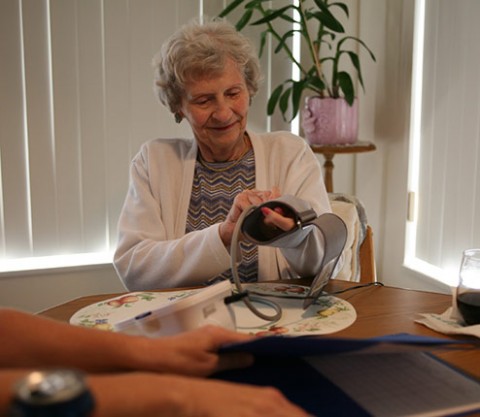
High blood pressure can lead to more than just heart problems. Among other things, it is directly related to decreased cognitive functioning, according to research. That’s why is important to carefully monitor a senior with high blood pressure.
Q. My 75-year-old widowed mother just had a physical and her doctor said her heart is in great shape. She does have borderline high blood pressure, though, so the doctor has prescribed a medication. Are there other things she could do?
It sounds as if your mother has taken good care of herself if her heart is in such a healthy condition. One important component of good heart health is blood pressure, and the risk of high blood pressure does seem to increase with age, according to the American Heart Association. In fact, 90 percent of Americans over the age of 50 have a lifetime risk of high blood pressure.
High blood pressure can lead to other problems, too. Increased blood pressure in older adults is directly related to decreased cognitive functioning, particularly among seniors with already high blood pressure, research reveals. This means that stressful situations may make it more difficult for some seniors to think clearly.
Dr. Jason Allaire, an assistant professor of psychology at North Carolina State, who co-authored a study on high blood pressure and cognitive function, explains that study subjects whose average systolic blood pressure was 130 or higher saw a significant decrease in cognitive function when their blood pressure spiked. However, Allaire notes, study subjects whose average blood pressure was low or normal saw no change in their cognitive functioning — even when their blood pressure shot up.
So how do you navigate around high blood pressure and its consequences? Your mom’s doctor will be her best source of information for lifestyle and diet changes.
“High blood pressure remains an epidemic in the United States, but it can be prevented,” said Lawrence Appel, M.D., lead author of an American Heart Association scientific statement, published in Hypertension: Journal of the American Heart Association. “By improving their diet, people can reduce their blood pressure and put a major dent in their risk of stroke, coronary heart disease and heart failure,” said Appel, a professor of medicine at Johns Hopkins University School of Medicine in Baltimore.
The statement also recommends combining an overall healthy diet with weight loss, eating lots of fruits and vegetables, limiting alcohol consumption, lowering salt intake and increasing potassium intake.
The National Heart, Lung and Blood Institute Health Information Center recommends following its Dietary Approaches to Stop Hypertension (DASH) plan. The DASH eating plan is rich in fruits, vegetables, fat-free or low-fat milk and milk products, whole grains, fish, poultry, beans, seeds and nuts. Talk to your doctor about whether the DASH plan will work for you. The plan also recommends being moderately active for at least 30 minutes on most days of the week.
If your mother lives alone, you might want to consider a companion for her. Encourage her to develop a relationship with someone who shares some of her same health interests and concerns. Or contact the local Home Instead Senior Care® office. The organization employs CAREGiversSM who can help seniors with meal preparation, errands and shopping, and serve as companions.
Here’s hoping your mother has many more years of healthy heart living.
Here’s hoping your mother has many more years of healthy heart living.
Scrapbooking For Seniors
Friday, December 30, 2011

Along with reminiscing activities and other activities that get seniors talking about their lives, this is the perfect way to get them interested in something and to keep their minds sharp. Not only is this an idea that they can work on to have something special to do, it can also be something they can do with their family. This activity can be something that is an ongoing project that they work on in their own time by themselves, or when their friends and family are visiting. Each person visiting can contribute something to the scrapbook. Grandchildren can be especially helpful and encouraging when it comes to putting the scrapbook pages together.
Once or twice a month have a follow up activity where seniors discuss their scrapbooks to show and tell what they have done up to that point. During this activity, they can share ideas just like any other scrap-booking group does. When a scrapbook is completed, offer them the chance to start another one if they would like to.
This is a good activity to keep seniors motivated. It is also something that can encourage inter-generational contact.
Enter to Win a Family Reunion!
Thursday, December 22, 2011
Enter to Win a Family Reunion!
Gathering together to share and preserve family stories helps to keep the memories alive, especially for families touched by Alzheimer’s disease. What’s your family’s story? Tell us how Alzheimer’s has impacted your family, and how you cope with the challenges of the disease. You could win an unforgettable family reunion event funded by Home Instead Senior Care and valued at up to $10,000! See the prize details for specifics, and don’t forget to tell us why your family deserves to win this once-in-a-lifetime experience.
Click this link for more info: http://www.helpforalzheimersfamilies.com
7 Signs Santa Has Alzheimer's
Monday, December 12, 2011

Doctors know well that the holidays bring an upturn in families noticing worrisome signs of memory loss in older adults. No disrespect to Santa intended, but Jolly Old St. Nick also shows a worrisome number of not-so-jolly potential symptoms of dementia.
Only a doctor, of course, can diagnose Alzheimer's disease. But Mrs. Claus would do well to take a closer look at the following warning signs, which warrant a cognitive evaluation and medical exam in order to rule out other possible causes of dementia or -- though it seems impossible to imagine in s someone known for his ho, ho, ho -- depression.
1. Santa keeps making that list and checking it twice.
People with early memory loss are often aware that they're slipping, and they struggle to employ strategies to help them keep track. Writing notes to themselves is one way they do this. Eventually, though, the person with cognitive trouble forgets ever having written a list in the first place and then never consults it later.
Why does Santa check his list twice? Maybe he's just careful -- after all, it's a long list. But obsessively checking and rechecking a note or the clock -- often because you literally can't remember just having done so -- is a common sign of memory loss. The ability to record these new memories is impaired.
2. He wears the same clothes over and over.
Have you ever seen Santa wearing anything besides that fur-trimmed red suit? Wearing the same clothes repeatedly is another hallmark of advancing cognitive difficulty.
It's possible, of course, that the red suit is just Santa's chosen uniform, a la Steve Jobs -- but even Jobs ditched his signature black turtleneck and jeans for sleeping or sports. If Mrs. Claus has to sneak the suit out of the room at night in order to wash it every now and again, or if there are blue and yellow suits hanging in the closet that never get selected, she might consider this a red flag.
3. He needs a red-nosed reindeer to direct him on the same route he's driven for years.
You'd think Santa would know his worldwide sky routes like the back of his hand by now, instead of having to seek out a bright-nosed reindeer to lead the way.
But getting lost on familiar routes is often one of the earliest memory symptoms families notice. One classic clue: driving the same way for years but suddenly having moments of confusion during which he or she isn't certain of the location or destination. Both memory loss and "motion blindness" -- the ability to perceive motion well and navigate the environment -- are to blame.
If kids in Tokyo or Toledo wake up without any toys this Christmas, it just might be because Santa got lost in Tibet.
4. He's getting up there in years.
Alzheimer's disease isn't an inevitable side effect of aging. But the odds of developing it doincrease with age. As many as one in two people over age 85 have signs of dementia. And Santa is how old? Multiple centuries?
5. He asks the same questions over and over. ("What do you want for Christmas?" "Have you been a good little girl?")
Spend a few minutes with someone with mild dementia, and repetition -- of questions, comments, and even word-for-word long anecdotes -- is often apparent. The person may seem to get stuck on just a few phrases with certain people or in certain situations. Always asking a grandchild, "How's school?" or an adult child, "How's the family?" for example, are helpful crutches that the person with mild dementia may use to mask an underlying uncertainty.
Makes you wonder what Santa has ever said to a child around the globe besides, "What do you want for Christmas?" and "Have you been good?" You'd think he'd have plenty of stories and advice to share, but we just don't hear it.
6. He's obese.
The exact cause of Alzheimer's is unknown. But scientists have uncovered plenty of risk factors. High on the list: obesity. Santa's exact weight is unknown, but nobody looking at that bowl full of shaking jelly would place him inside the "normal" columns of the body-mass-index chart.
Belly fat (weight centered in the midsection) is clearly associated with an increased risk of Alzheimer's disease, especially when it accumulates in midlife. People who are obese also tend to develop diabetes and heart disease, which are themselves linked to a higher risk of dementia.
7. He's prone to mistaking the chimney for a door, and to calling musical instruments "rooty-toot-toots and rummy-tum-tums."
It's hard to understand why Santa chooses to use the chimney over the door, given that everyone's supposed to be asleep anyway and given how often he flops into fires and ashes. But cognitive difficulties often cause confusion in behavior and language.
Misusing words, a part of a general condition of language problems called aphasia, is another common development with dementia. Some people with dementia call a toothbrush a "mouth scraper" or a "thingamajig," for example. Songs about Santa refer to "rooty-toot-toots" and rummy-tum-tums" for musical instruments. Hmmm. . . .
Here's hoping those hardworking toymaker elves are also good at caregiving, since -- as far as we know -- Mr. and Mrs. Claus have no children of their own up at the Pole to step up to the demands of the job.
Brought to you by: Caring.com
Brought to you by: Caring.com
Don't forget to sign up for "Home for the Holidays" FREE Web Conference will Help Family Caregivers
Friday, December 2, 2011

Home for the Holidays FREE Web Conference will Help Family Caregivers
Going home for the holidays often leaves family members shocked at the declining health or independence of a loved one. Warning signs can help make decisions that will keep your senior safe long after you've returned home.
To learn more about these signs, register for theFREE Home for the Holidays web conference.
The web conference will help you recognize thewarning signs that indicate your senior loved one might need additional help for things such as loss of appetite, unwanted weight fluctuations, spoiled food in the fridge or clutter. Whether you're a long-distance caregiver or just live down the street, the holidays are a good time to assess the situation with Mom and Dad, and help them come up with a solution if necessary.
The web conference will be:
- Moderated by a Home Instead Senior Care® representative
- Hosted by the American Society on Aging (ASA)
- Co-sponsored by the National Family Caregivers Association (NFCA) and the National Alliance for Caregiving (NAC).
The hour-long web conference will be offered on Eastern Time.
10 Signs that a Senior Might Need More Help at Home
- A change in appearance or condition of the home
- Clutter
- Dirty or unkempt clothing
- Unpaid bills
- Fresh food replaced with junk food
- Spoiled food in the fridge or freezer
- Bugs or rodents in the home
- Confusion
- Unfilled prescriptions
- Spills on floors and countertops
Subscribe to:
Posts (Atom)